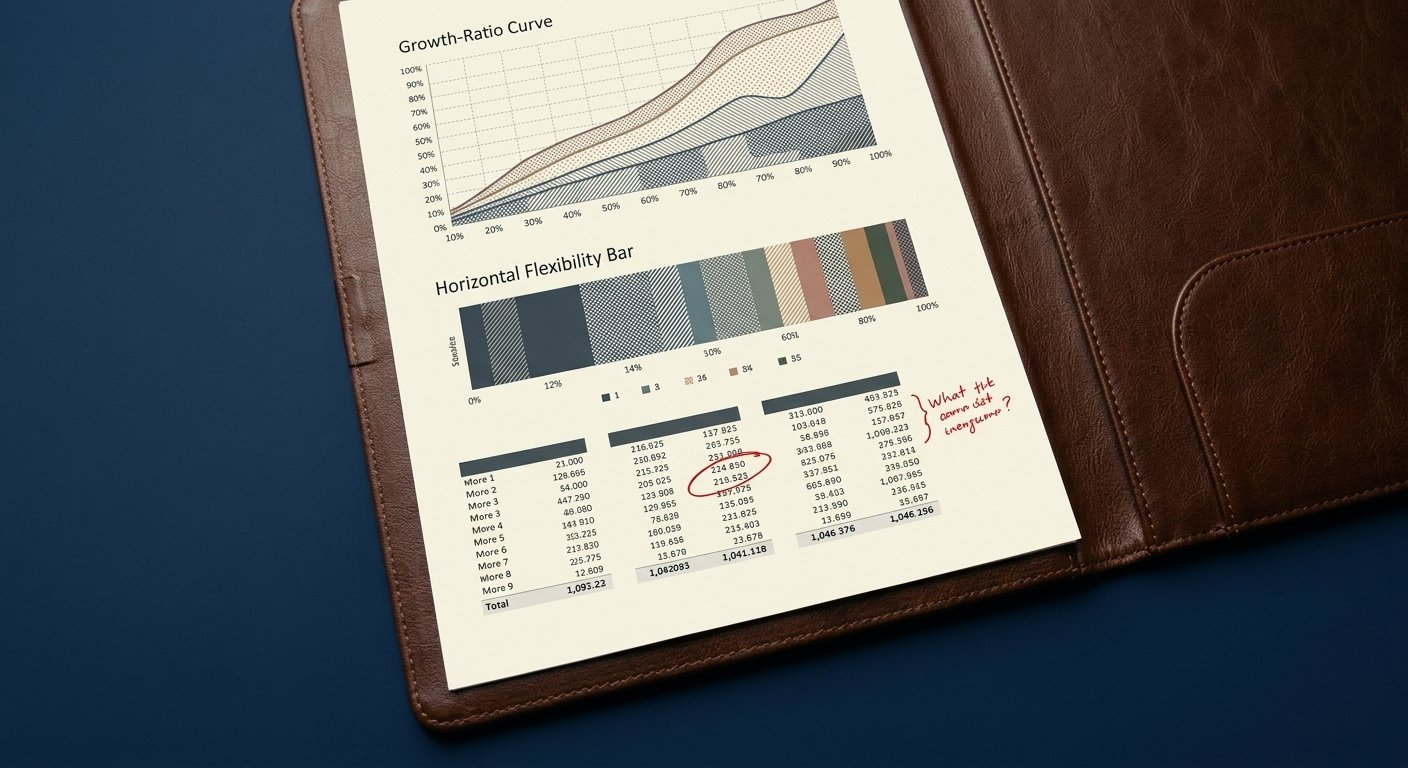
The CIO who presents the IT budget by tool category is answering a question the CFO did not ask. The CFO is evaluating flexibility, risk concentration, growth trajectory, and cash-flow shape. If those are not what the presentation is about, the presentation is not landing.
That mismatch is the reason a lot of CIO-CFO conversations feel adversarial when they should be collaborative. It is also the reason a lot of IT budgets get cut in ways that surprise the CIO, even after what the CIO thought was a strong presentation.
The disconnect
The IT function has been trained, over decades, to describe its work in terms of the technology it runs. Applications. Infrastructure. Cloud. Security. Vendors. Headcount by team. That is what an IT budget presentation typically breaks down into, and it is what the CIO has been rewarded for defending in the past.
The CFO reads a different set of questions from the same numbers.
What the CFO is actually reading
Is IT spend growing faster than the business? If IT spend is compounding at a rate above the enterprise's revenue growth, the CFO is watching a margin problem develop, and no amount of tool-category detail is going to make that problem go away.
What is the mix of run, grow, and transform spend? Mature enterprises split IT spend into three buckets, not two. Run-the-business keeps existing systems operating. Grow-the-business scales the current model. Transform-the-business changes what the enterprise is. The healthy shape depends on strategy, but a rough 70/20/10 split is the reference point most CFOs benchmark against. If run is compounding at the expense of grow and transform, the enterprise has less flexibility to invest in what produces future revenue. That mix is the CFO's leading indicator of whether IT is a growth partner or a growth constraint.
What is the cash-flow shape of the commitments? Multi-year vendor contracts, cloud reserved-instance and consumption commitments, AI infrastructure capacity minimums, and hardware refresh cycles produce a cash-flow profile the CFO has to manage. This concern has escalated as hyperscaler capacity commitments have moved from single-year budgeting into multi-year strategic exposures large enough to appear on the earnings call. An IT presentation that reports on annual budget without addressing what the commitments look like over three to five years is missing what the CFO is actually stress-testing.
What happens to the number if the business contracts? If revenue drops materially in a downside scenario, which parts of the IT budget can flex, and which parts are locked in? That question determines whether IT is a fixed cost or a variable one at the enterprise level, and it changes the CFO's willingness to defend IT investment during a downturn.
What is the vendor concentration risk? If any single vendor represents more than a defined percentage of IT spend, or more than a defined percentage of enterprise-critical capability, that is a risk the CFO reports up. The CIO who has not surfaced that concentration proactively has surfaced it eventually anyway, and less favorably.
None of those questions is answered by a tool-category breakdown.
What IT presents that never lands
The typical IT budget presentation is a bottom-up view. It rolls up from the individual project, application, or vendor line item, and it defends the total by explaining what each component is doing. That view is useful for internal operating decisions. It is close to useless as a CFO conversation.
The reason is that the CFO does not care why the enterprise has forty-seven applications. The CFO cares whether the total spend is growing faster than the business, whether the shape of the commitments allows flexibility, and whether the risk profile is defensible to the board. Explaining that each of the forty-seven applications is individually necessary does not answer those questions.
The IT function that is described bottom-up gets evaluated bottom-up. Each line item becomes a defense. Every renewal becomes a negotiation. The overall strategy of the IT function never surfaces because the presentation format never asks for it.
The reframe that changes the conversation
The move that changes the CFO conversation is to present the IT budget as a set of business decisions to make rather than a set of numbers to approve.
Growth ratio. State explicitly how IT spend is growing relative to the business, and whether that ratio is the intended one or has drifted. If it has drifted, propose the moves that bring it back into alignment. The CFO now has a decision to make about growth alignment rather than a number to defend.
Flexibility profile. State explicitly what portion of the IT budget is fixed, what portion is variable, and what portion is discretionary. Show what the number looks like under a business-contraction scenario. The CFO now has a working model of IT as a controllable cost rather than an opaque one.
Concentration and risk. State explicitly where the concentration sits, whether it is deliberate, and what the mitigation profile looks like. The CFO now knows the CIO is thinking about the same risks the CFO is watching for, which is the strongest signal of trust the CIO can send in a budget conversation.
When those three sit at the top of the presentation and the tool-category detail sits underneath as backup, the conversation moves. The CFO evaluates decisions rather than defending numbers. The CIO earns the standing to make future investment cases because the current one addresses the CFO's actual read.
The disciplines the CFO increasingly expects the CIO to speak in, Technology Business Management (TBM) and FinOps, are structured around exactly these questions. TBM is now used by most of the Fortune 100 to give CFOs a view of technology spend they can actually evaluate. FinOps does the same for cloud, and increasingly for AI capacity. The CIO who is fluent in one or both is speaking the CFO's language before the presentation begins.
What the CIO actually owns
The CIO owns the framing of the IT function to the executive team. The CFO conversation is the most consequential version of that framing, because the CFO's read of the IT function tends to propagate to the CEO, the board, and the rest of the executive team.
The CIO who defends numbers stays a numbers person. The CIO who brings decisions changes the standing of the IT function in the enterprise.
The reframe does not require a new budget. It requires a new presentation of the existing budget, oriented around the questions the CFO is actually asking, and the willingness to hold a business-decisions conversation rather than a tool-category one. That is a framing change rather than a spreadsheet change. And for most CIOs, it is the single highest-leverage move available in the executive relationship.
Adam Cooper is a Marine Corps veteran who leads global technology operations across maritime, transportation, hospitality, and industrial environments. He writes about enterprise IT governance, distributed operations at scale, and the executive dynamics of senior technology leadership. Connect on LinkedIn or Send Email.