There was a filter on every AI proposal I made or even thought of. Could the data leave the building? If the answer was no, the proposal was dead before it was written. The filter was so consistent that I stopped writing the proposals it killed.
I run distributed IT across roughly 250 vessels and 100-plus offices. The operating constraints in my seat are not exotic. Regulated jurisdictions. Customer payment data. Crew records. Vessel positions and routes. Some of it leaves my control by exception, with paperwork and a reason. Most of it does not leave at all. Anything that needs to reason over that data needs to do it inside our boundary.
That meant frontier AI was a vendor demo and a planning exercise, not a deployment. The frontier model lived in someone else's data center. The data path went through a network I did not own to a tenant I could not audit to a model whose weights I could not see. The economics did not pencil at our token volume. The audit trail did not anchor where it needed to anchor. The proposal was dead at the filter.
The dream of moving the model on-premises was not new. I had thought through what it would take. A single-box rig with enough unified memory to host an open reasoning model like DeepSeek R1 at workable quantization. Quiet enough to sit in a server closet. Quantization aggressive enough to fit the model. Throughput tolerable enough to be useful. I ran the math more than once. The math worked. The path to having one of these in a production environment did not. No enterprise support contract. No Windows integration. No vendor-grade security model. No agent runtime that would survive a corporate security review. A pile of impressive math with no production path.
NVIDIA spent this week in Taipei changing the filter.
The week the constraint moved
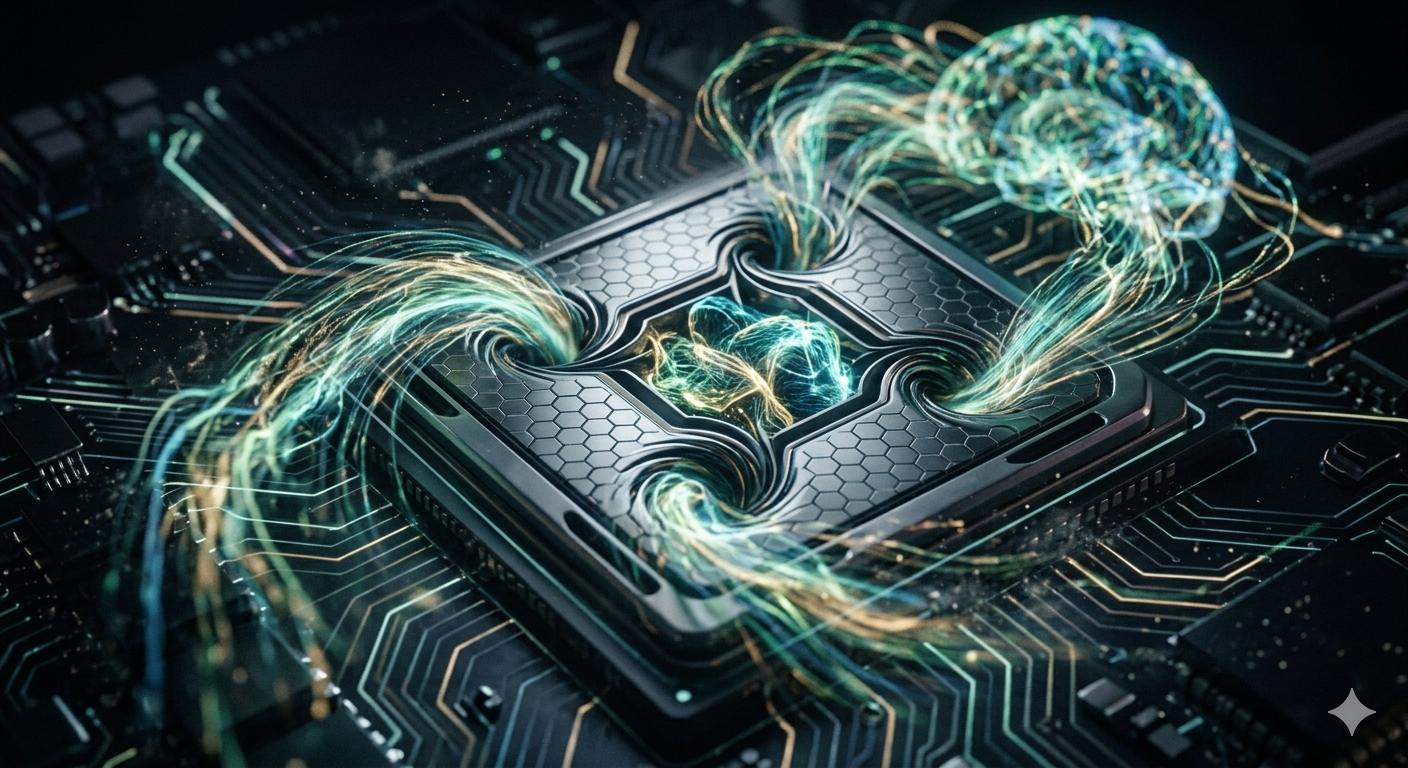
The headline product is DGX Station for Windows. A deskside machine, 748 gigabytes of coherent memory, 20 petaflops of FP4 performance, running frontier models up to a trillion parameters locally. Built on the GB300 Grace Blackwell Ultra superchip. Microsoft is the partner. Q4 availability.
That last sentence does not capture the change. It describes the product. The change is that for the first time, a frontier-class model fits inside hardware an enterprise can own. Not a stripped-down version. Not a distilled student. The frontier itself, on a machine that sits under a desk inside your boundary.
NVIDIA also pushed the rack version forward. Vera Rubin is in full production, fanless and cable-free at a 45-degree-Celsius warm-water inlet, tray assembly down from two hours to five minutes. And on the small end, a Blackwell-and-Grace superchip called RTX Spark brings roughly a petaflop and 128 gigabytes of unified memory into a laptop or compact desktop. The press is calling the whole slate a PC reinvention. From inside my seat, the headline is simpler. The model can now live where the data lives.
This is not a new model of the same thing
I was not the only one running this math. The on-premises frontier dream was already being attempted across the field, in public. Apple silicon clusters chained together over Thunderbolt. Homelab rigs squeezing quantized DeepSeek R1 onto whatever unified memory they could afford. A year of forum posts, benchmarks, and proof-of-concept videos showing it works. What there has not been is a way to put any of it through corporate procurement and have it come out the other side as something a security team would sign off on.
DGX Station for Windows is not a faster version of those builds. It is a different category of object. A vendor-supported product. A Windows-native platform with a Microsoft co-development partner. A purpose-built agent runtime with policy enforcement and credential sandboxing. A coherent memory architecture engineered for this workload rather than borrowed from a workstation. A SKU that goes through enterprise channels with support contracts and warranty terms a CIO can hand to procurement.
The hardware is the small part of the change. The part that moves the line is everything else around it.
What the constraint cost, and what releases now
I wrote a month ago that AI earns its keep on bounded work and stays a research assistant on unbounded work. The line between those categories is not a property of the work. It is a property of the infrastructure underneath it. Cloud-only frontier models made entire categories of work permanently unbounded for operators in seats like mine, not because the work itself was unbounded but because the infrastructure forced it to be. The audit trail could not anchor. The data path could not be closed. The economics could not be reasoned about at our scale.
Move the model on-premises and that pressure releases. The data path closes. The audit trail anchors. The token economics turn into capital and depreciation, which is math my CFO knows how to do.
That does not make every on-premises AI project a good idea. It makes the category of "good idea" larger than it was last quarter. That is the only category change that matters.
What this does not change
A new product is not a new operating reality. The same things that were hard about deploying AI in production last week are hard this week.
The audit trail problem is unchanged. If you would not let a cloud model take autonomous action against production yesterday, the same model running locally does not change the answer. Where the GPU sits is not the question. Who gets logged as the decision-maker is the question. The hardware does not write the policy.
The change-management problem is unchanged. A deskside trillion-parameter model still needs an integration plan, a rollback path, a security review, and a finance owner. Q4 availability is at least two more quarters before a single agent does anything load-bearing in an enterprise environment. Build the runway now.
The bill is unchanged in shape, larger in magnitude. The new racks ship with power-smoothing hardware engineered to protect the electrical grid from the load swings these systems create. You do not engineer that unless the draw is severe. Whatever the deskside number ends up being, the rack-scale number is the one that matters for anyone planning at scale. Plan for power, not just for purchase.
And the supply chain did not move. The whole stack still runs through one island. Roughly 150 ecosystem partners stand behind Vera Rubin alone. That is an engineering triumph and a geopolitical single point of failure in the same sentence. No product release changes it.
What I'm doing about it Monday
Inventory the work the filter killed. Pull every AI proposal that died at the data-residency or audit-trail filter in the last twenty-four months. Most of those proposals are now worth a second look. Not all. The ones worth re-opening are the ones whose only blocker was infrastructure. The ones blocked by audit-trail policy or process risk are still blocked.
Build the cost model before the procurement model. A deskside SKU is a line item. A frontier-class on-premises deployment is a power plan, a thermal plan, a security plan, and a depreciation plan. If your finance organization has only modeled cloud AI spend, the on-premises model is a different exercise. Start it now, not in Q4.
Decide which work belongs on which infrastructure. Not every workload needs the frontier. Most do not. The shift this week is that, for the workloads that do need it and could not leave the building, the answer changed. For everything else, the answer did not. Sorting the two is the work that pays off all year.
Hold the line on bounded versus unbounded. The hardware moved. The principle did not. AI proposes. Humans decide on anything unbounded. The audit trail anchors at a human. If you needed that discipline yesterday, you still need it today. A trillion-parameter model on hardware you own is a more capable research assistant. It is not a more capable decision-maker.
The filter has moved. The discipline has not. Knowing which one is which is the operating work of the next year.
Sources: NVIDIA's live GTC Taipei at Computex coverage and online press kit; keynote reporting from SiliconANGLE, ServeTheHome, Tom's Hardware, Digitimes, and GeneOnline (June 1, 2026). Performance, memory, and cost figures are vendor-stated and not independently benchmarked as of publication.
Adam Cooper is a Technical Director writing about distributed IT operations, maritime technology, and AI in production environments. Connect on LinkedIn or Send Email.